Why Aftercare Makes or Breaks Your Fat Dissolving Results, The Role of Lymphatic Drainage, Hydration, and Intermittent Fasting
Published Date: July 12, 2026
Published By: Jac Cantos, Pep Glow Aesthetics™️
Most clients think the treatment ends when they leave the clinic. It does not.
With LemonZest LB-1000™️by PepGlow Aesthetics, what you do in the 48 to 72 hours after your session has a direct and measurable impact on the quality of your final result. The lipolytic process triggered during your appointment continues working for weeks, and the decisions you make during that window either support that process or slow it down.
This is not a list of precautions. It is a guide to understanding what is happening inside your body after treatment, and why each aftercare step is a clinical instruction, not a suggestion.
What Is Actually Happening After Your Session
When LemonZest LB-1000™️ is administered, Bromelain disrupts the membranes of targeted adipocytes, and Lecithin emulsifies the released fat content into free fatty acids and glycerol. That breakdown is only Stage 1. The work of Stage 2, the elimination of those fat metabolites from your body, begins the moment you leave the treatment room and continues over the following two to four weeks (Salti et al., Dermatol Surg., 2008).
The lymphatic system is the primary transport network for this clearance. Unlike the circulatory system, the lymphatic system has no pump, it relies entirely on movement, muscle contraction, and manual stimulation to move fluid. This is why what you do immediately after treatment matters so much.
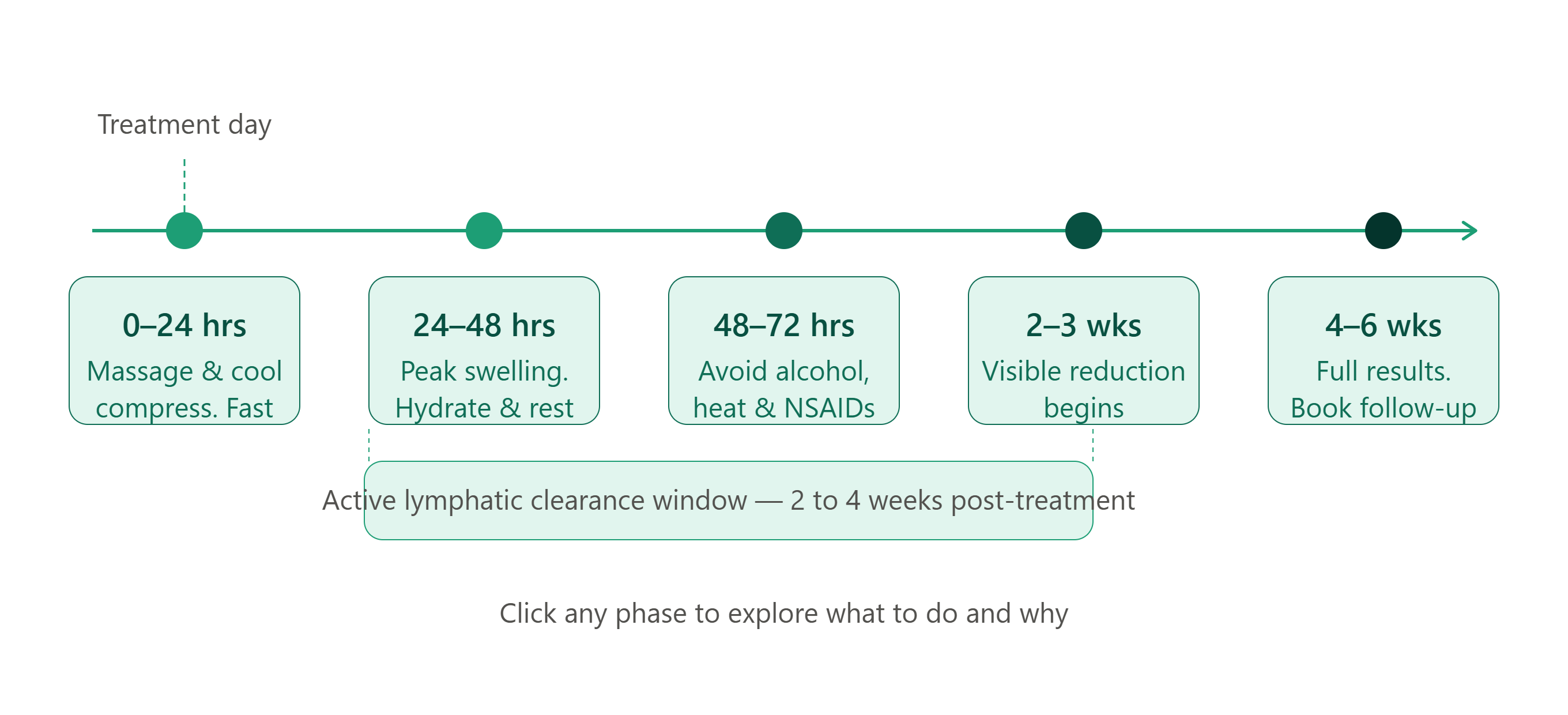
The post-treatment timeline below maps the key recovery phases.
Step 1: Lymphatic Drainage Massage - Start Immediately
The single most important thing you can do at the end of your treatment session, and in the days that follow, is massage the treated area firmly and consistently.
Immediately after injection, your treating professional will massage the entire treatment zone for two to three minutes (body areas: three to five minutes). This serves two functions: it distributes the product evenly through the fat layer, and it begins stimulating the lymphatic vessels to move the emulsified fat away from the treatment site. This is not optional comfort care, it is a clinical step built into the treatment protocol.
At home, continue with gentle circular massage of the treated area for five minutes, twice daily, for three days following your session. The lymphatic system depends on external stimulation to clear metabolic waste efficiently, and consistent massage is the most direct way a client can actively support their own results (Rotunda & Kolodney, Dermatol Surg., 2006).
Step 2: Hydration - 2 Litres Every Day, Starting Now
Begin drinking water immediately after treatment, and maintain a minimum of two litres per day throughout the recovery period.
This is not general wellness advice. After lipolysis, the freed fatty acids and glycerol travel through the lymphatic system and bloodstream before being processed by the liver and eliminated via urine and sweat. This elimination pathway requires adequate fluid volume to function efficiently. Dehydration slows lymphatic transit, reduces urinary output, and impairs hepatic processing, all of which extend the time it takes for destroyed fat cells to clear (Salti et al., Dermatol Surg., 2008; Duncan & Palmer, Aesthet Plast Surg., 2008).
Clients who maintain consistent hydration across the recovery window tend to see clearer, faster-progressing results at the two to three week mark when initial fat reduction first becomes visible.
Step 3: Intermittent Fasting the Next Morning - The Metabolic Reason
One of the more surprising aftercare instructions is this: do not eat until noon the day after your treatment. This is not a general dietary recommendation, it has a specific metabolic rationale.
Time-restricted feeding has been shown to support fat oxidation by lowering insulin levels and increasing lipolytic enzyme activity during the fasting window (Hatori et al., Cell Metab., 2012). After your treatment, your body is actively processing a significant volume of free fatty acids and glycerol released from disrupted adipocytes. Eatingm particularly carbohydrate-heavy foods, triggers an insulin response that suppresses fat oxidation and shifts the body's metabolic priority away from clearing the released fat.
By extending the overnight fast until noon, you keep the metabolic environment favourable for fat clearance during the period when lipolytic activity is highest. Eat a light meal before your session, hydrate well, but allow the fasting window to do its work the following morning.
What to Avoid - And Why Each Restriction Has a Mechanism
Every restriction in the aftercare protocol exists for a biochemical reason. Understanding the "why" makes compliance straightforward.
Avoid alcohol for 72 hours. Alcohol is processed by the liver, the same organ responsible for metabolising the free fatty acids released during lipolysis. Alcohol consumption redirects hepatic capacity away from fat clearance and also causes vasodilation, which increases bruising and slows the resolution of post-procedural swelling.
Avoid NSAIDs such as ibuprofen. The mild inflammatory response triggered by LemonZest LB-1000™️is therapeutically intentional, it is what stimulates fibroblast activity and collagen production in Stage 3 of the treatment mechanism (Hexsel et al., JEADV, 2009). Suppressing this inflammation with NSAIDs blunts the skin-tightening benefit. Paracetamol is acceptable for discomfort.
Avoid hot environments, saunas, steam rooms, sunbeds, and hot baths, for 48 hours. Heat causes vasodilation and increases localised swelling in areas that are already processing post-procedural oedema. It also places additional metabolic demand on a body already managing a significant clearance process.
Avoid strenuous exercise for 24 to 48 hours. While light walking is actively encouraged (it supports lymphatic flow), intense exercise increases blood flow to the treated area and can exacerbate bruising and swelling before the initial inflammatory phase has resolved.
What to Expect - Normal vs. Concerning
Knowing what normal looks like removes anxiety and helps clients stay the course through the recovery window.
Swelling and puffiness are expected and peak at 24 to 48 hours before resolving over one to two weeks. Tenderness and soreness in the treated area typically resolve within three to five days. Bruising is common and clears over seven to fourteen days. A feeling of firmness under the skin is normal, this is the treated tissue responding as adipocyte debris is progressively cleared by the lymphatic system. It resolves over two to four weeks.
Visible fat reduction typically begins at two to three weeks post-treatment. Full results are seen at four to six weeks. Most clients require two to four sessions for optimal outcomes, spaced four to six weeks apart to allow each clearance cycle to complete before the next session (Salti et al., Dermatol Surg., 2008).
If you experience prolonged swelling beyond two weeks, signs of skin ulceration, significant allergic reaction, or nodule formation, contact your treating professional promptly.
Medical References
Rotunda AM, Kolodney MS. Mesotherapy and phosphatidylcholine injections. Dermatol Surg. 2006;32(4):465–480.
Salti G, et al. Phosphatidylcholine and sodium deoxycholate in treatment of localised fat. Dermatol Surg. 2008;34(1):60–66.
Hatori M, et al. Time-restricted feeding prevents metabolic diseases. Cell Metab. 2012;15(6):848–860.
Hexsel D, et al. A validated photonumeric cellulite severity scale. JEADV. 2009;23(5):523–528.
Duncan DI, Palmer M. Fat reduction using phosphatidylcholine/deoxycholate injections. Aesthet Plast Surg. 2008;32(5):858–872.
Pep Glow Aesthetics™️: Medically Guided Peptide Therapy for Weight Loss, Skin Renewal, and Longevity
Pep Glow Aesthetics™️ provides medically guided, science-backed peptide therapy protocols designed to support sustainable weight loss, advanced skin regeneration, and cellular longevity. Serving individuals who seek safe, effective, and professionally managed wellness solutions, our approach focuses on optimizing health at the cellular level, not quick fixes.
Our expert-managed protocols, including PepSlim™️, AuraCell™️, VitaCore™️, GluthaPrime™️, LemonZest™️, Deer Placenta, and Elyte Drops, emphasize precision dosing, medical oversight, and evidence-based care. By combining modern peptide science with structured monitoring, we help clients achieve measurable, long-term results while prioritizing safety and transparency.
Whether your goal is metabolic optimization, aesthetic rejuvenation, or overall vitality, Pep Glow Aesthetics™️ offers tailored solutions guided by clinical expertise. To learn more or schedule a consultation, contact us at [email protected] or visit pep-glow.com.
Disclaimer: This content is for general informational purposes only and does not constitute medical advice. Peptide therapy should always be administered under professional medical supervision. Individual results may vary. For guidance specific to your health needs, please consult with a qualified healthcare provider. For questions, comments, or feedback, feel free to email us at [email protected].
