What Happens to Your Fat After Dissolving Injections? A Step-by-Step Guide to How Your Body Eliminates It
Published Date: September 20, 2026
Published By: Jac Cantos, Pep Glow Aesthetics™️
One of the most common concerns clients raise before their first fat dissolving session is this: "Where does the fat actually go?"
It is a completely reasonable question. The idea of fat being "dissolved" sounds dramatic, and without understanding the biology behind it, it is easy to worry that the fat is simply shifting somewhere else, or accumulating in an organ, or causing harm further down the line.
The reality is far more orderly. LemonZest LB-1000™️ by PepGlow Aesthetics does not move your fat, it triggers a biological process that destroys adipocytes and hands the released content to your body's own elimination systems. Those systems, your lymphatic network, your bloodstream, your liver, and your kidneys, already process fat every single day. The treatment simply accelerates and focuses that process in a targeted zone.
Here is exactly what happens, step by step.
Step 1: The Fat Cell Is Disrupted
Everything begins at the moment of injection. LemonZest LB-1000™️ delivers a pharmaceutical-grade blend of Bromelain, Lecithin, and Riboflavin into the subcutaneous fat layer of the treatment area.
Bromelain, a proteolytic enzyme derived from pineapple, penetrates and disrupts the membrane of the adipocyte (fat cell). Once the membrane integrity is compromised, the fat cell can no longer hold its contents. The stored triglycerides inside the cell are released (Masson et al., Planta Med., 2014).
Lecithin, a phospholipid, immediately begins emulsifying those released triglycerides, breaking them down into smaller molecules: free fatty acids and glycerol. This emulsification is critical because it converts the fat from a large, insoluble lipid mass into a form the body's transport systems can actually move and process (Rotunda & Kolodney, Dermatol Surg., 2006; Hexsel et al., J Drugs Dermatol., 2003).
Riboflavin (Vitamin B2) supports this entire first stage by activating lipid metabolism at a cellular level and reducing localised oedema in the treated tissue (Powers, Am J Clin Nutr., 2003).
The fat cell does not reform after disruption. Once an adipocyte membrane is destroyed, that cell is gone. The body does not regenerate destroyed fat cells in the same location, making the results of fat dissolving treatment permanent, provided the client maintains a stable weight.
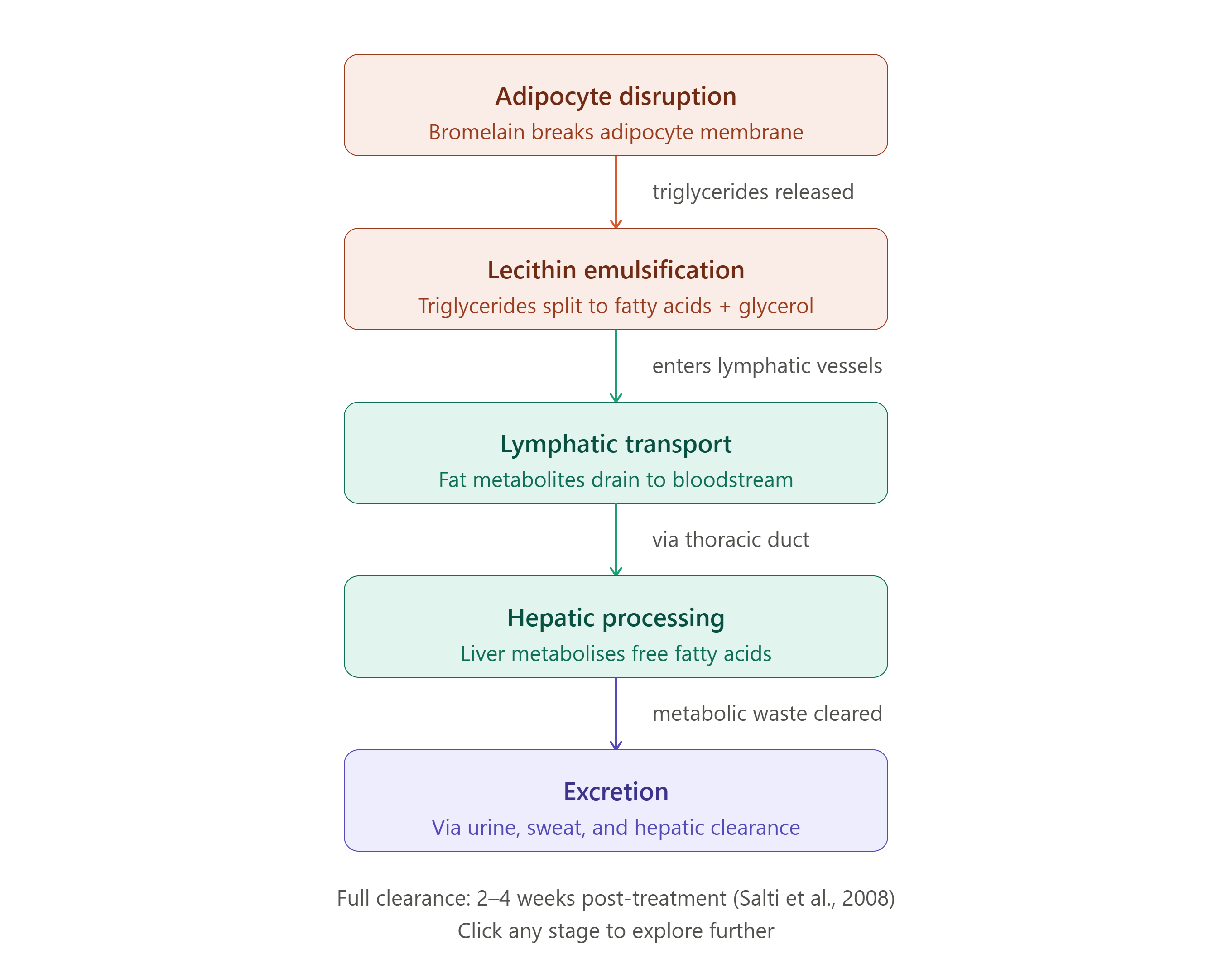
The elimination pathway below shows how the released fat content travels from that moment onward.
Step 2: The Lymphatic System Takes Over
Once the fat has been emulsified into free fatty acids and glycerol, it enters the lymphatic vessels in and around the treatment area. This is the body's primary drainage network — a system of vessels, nodes, and fluid (lymph) that runs parallel to the circulatory system and is responsible for clearing cellular waste, toxins, and metabolic byproducts from tissue.
Unlike blood, which is pumped by the heart, lymphatic fluid moves passively. It relies on muscle contractions, body movement, and external stimulation — which is precisely why post-treatment massage is a clinical requirement rather than an afterthought. Firm massage of the treated area immediately after injection, and for several days following treatment, directly stimulates lymphatic flow and accelerates the movement of fat metabolites away from the treatment site (Rotunda & Kolodney, Dermatol Surg., 2006).
The free fatty acids and glycerol travel through increasingly large lymphatic vessels until they reach the thoracic duct — the body's largest lymphatic vessel — which empties into the bloodstream near the left collarbone. From there, the fat metabolites enter general circulation.
This lymphatic transit phase is why hydration matters so much during recovery. A minimum of two litres of water daily is recommended throughout the post-treatment period because adequate fluid volume supports lymphatic throughput and reduces the time metabolites spend in transit (Salti et al., Dermatol Surg., 2008).
Step 3: The Liver Processes the Released Fat
Once free fatty acids enter the bloodstream via the lymphatic-to-venous junction, they travel to the liver — the body's primary metabolic processing centre.
The liver is already equipped to handle free fatty acids as part of its normal daily function. It processes them through beta-oxidation, the same metabolic pathway it uses to metabolise dietary fat, breaking them down into usable energy or converting them into compounds the body can safely excrete (Powers, Am J Clin Nutr., 2003). The glycerol released from triglyceride breakdown is similarly metabolised — it enters glycolysis pathways and is used as a metabolic substrate or cleared.
This is why healthy liver and kidney function is a prerequisite for treatment. Clients with diagnosed liver or kidney disease cannot safely undergo fat dissolving treatment because their clearance capacity is already compromised — adding a significant bolus of fat metabolites to an impaired system creates unnecessary metabolic burden (Duncan & Palmer, Aesthet Plast Surg., 2008).
It is also why a total session maximum of 100mL applies. This ceiling is not arbitrary — it reflects the practical capacity of the body's elimination systems to process the fat released in a single session without overloading hepatic and renal clearance.
Step 4: Excretion — Where the Fat Physically Leaves the Body
The final stage is elimination. The metabolic products of the liver's processing of free fatty acids leave the body through three primary routes: urine, sweat, and faecal excretion via bile salts produced from hepatic processing.
This is why the post-treatment protocol includes not eating until noon the following day. Time-restricted feeding maintains a low-insulin metabolic environment overnight, which keeps lipid oxidation pathways active and supports the clearance of fat metabolites rather than diverting hepatic resources toward food metabolism (Hatori et al., Cell Metab., 2012). It is a targeted, time-limited measure — not a long-term dietary intervention.
The destroyed adipocytes themselves — the structural remnants of the disrupted fat cells — are cleared by the immune system via phagocytosis over the weeks following treatment. Macrophages move into the treatment area, engulf the cellular debris, and remove it through the lymphatic system. This progressive clearance is why results are not immediate: visible fat reduction typically begins at two to three weeks post-treatment, with full results seen at four to six weeks as the clearance cycle completes (Salti et al., Dermatol Surg., 2008).
Does the Fat Come Back?
This is the follow-up question most clients have — and the biology here is reassuring.
Adult humans have a largely fixed number of adipocytes. When we gain weight, existing fat cells expand in volume; when we lose weight, they shrink. We do not typically generate significant numbers of new fat cells in adulthood. When LemonZest LB-1000™️ destroys adipocytes in a specific area, those cells are permanently eliminated and are not regenerated at that site.
However, the remaining fat cells in other areas of the body are unaffected — and if a client gains significant weight after treatment, those cells can expand, including in areas adjacent to the treated zone. The result of the treatment itself is permanent, but it is not a guarantee against future weight gain. Maintaining a stable weight following treatment preserves and extends results indefinitely.
Medical References
Rotunda AM, Kolodney MS. Mesotherapy and phosphatidylcholine injections. Dermatol Surg. 2006;32(4):465–480.
Masson W, et al. Bromelain: biochemistry and therapeutic application. Planta Med. 2014;80(16):1336–1345.
Hexsel D, et al. Phosphatidylcholine in treatment of localised fat. J Drugs Dermatol. 2003;2(5):511–518.
Salti G, et al. Phosphatidylcholine and sodium deoxycholate in treatment of localised fat. Dermatol Surg. 2008;34(1):60–66.
Powers HJ. Riboflavin (vitamin B2) and health. Am J Clin Nutr. 2003;77(6):1352–1360.
Duncan DI, Palmer M. Fat reduction using phosphatidylcholine/deoxycholate injections. Aesthet Plast Surg. 2008;32(5):858–872.
Hatori M, et al. Time-restricted feeding prevents metabolic diseases. Cell Metab. 2012;15(6):848–860.
Pep Glow Aesthetics™️: Medically Guided Peptide Therapy for Weight Loss, Skin Renewal, and Longevity
Pep Glow Aesthetics™️ provides medically guided, science-backed peptide therapy protocols designed to support sustainable weight loss, advanced skin regeneration, and cellular longevity. Serving individuals who seek safe, effective, and professionally managed wellness solutions, our approach focuses on optimizing health at the cellular level, not quick fixes.
Our expert-managed protocols, including PepSlim™️, AuraCell™️, VitaCore™️, GluthaPrime™️, LemonZest™️, Deer Placenta, and Elyte Drops, emphasize precision dosing, medical oversight, and evidence-based care. By combining modern peptide science with structured monitoring, we help clients achieve measurable, long-term results while prioritizing safety and transparency.
Whether your goal is metabolic optimization, aesthetic rejuvenation, or overall vitality, Pep Glow Aesthetics™️ offers tailored solutions guided by clinical expertise. To learn more or schedule a consultation, contact us at [email protected] or visit pep-glow.com.
Disclaimer: This content is for general informational purposes only and does not constitute medical advice. Peptide therapy should always be administered under professional medical supervision. Individual results may vary. For guidance specific to your health needs, please consult with a qualified healthcare provider. For questions, comments, or feedback, feel free to email us at [email protected].
